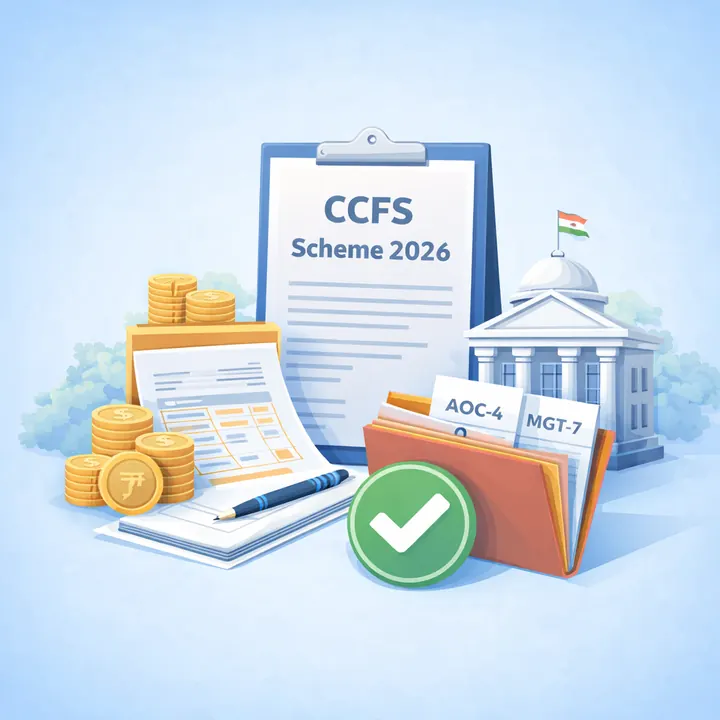
The Companies Compliance Facilitation Scheme 2026 (CCFS 2026) is closed: it ran from 15 April 2026 and, after two extensions, ended on 15 September 2026. While it was open, a company could clear overdue annual returns and financial statements by paying just 10% of the additional fee. A company that missed it now pays the full ₹100 a day per form, but filing quickly, dormant status and strike off still limit the damage.
Is CCFS 2026 still open?
No. The Ministry of Corporate Affairs closed CCFS 2026 on 15 September 2026, and its reduced fees do not apply to anything filed after that date. The scheme was extended twice, each time in the final week before the deadline then in force.
| Date | What happened |
|---|---|
| 24 February 2026 | General Circular 01/2026 announces the scheme |
| 15 April 2026 | Scheme opens, originally until 15 July 2026 |
| 8 July 2026 | General Circular 03/2026 extends it to 31 August 2026 |
| 31 August 2026 | General Circular 04/2026 extends it to 15 September 2026 |
| 15 September 2026 | Scheme ends |
On 10 August 2026 the ministry told the Lok Sabha that there was no proposal for a further extension, and three weeks later it granted one. Even so, no scheme applies to filings made today, and waiting for a new one only adds to the daily fee.
What CCFS 2026 offered companies
The scheme was a one-time condonation of delay under section 460 read with section 403 of the Companies Act 2013. It gave every eligible company three choices, each at a fraction of the normal cost.
- Catch up. File overdue MGT-7, MGT-7A, AOC-4 (including CFS, NBFC and XBRL versions), ADT-1, FC-3, FC-4 and old 1956 Act forms, paying the normal fee plus 10% of the additional fee.
- Go dormant. Apply for dormant status under section 455 in MSC-1 at half the normal fee.
- Close. Apply to strike off the company in STK-2 at 25% of the filing fee.
Companies already facing a final strike-off notice, those that had applied for strike off or dormant status before the scheme, companies dissolved by amalgamation and vanishing companies were excluded. Uptake was large: by 13 July 2026, 92,826 Indian and 33 foreign companies had used the scheme, 99 had filed MSC-1 and 11,829 had filed STK-2, according to a Lok Sabha reply of 20 July 2026.
What happens to companies that did not use the scheme
General Circular 01/2026 told each Registrar of Companies to take action under the Act, once the scheme ended, against companies still in default. In July 2026 the ministry told Parliament that, with the scheme extended, the list of non-compliant companies was not final and there were not yet grounds for enforcement.
The exposure is the same as before the scheme, only larger because time has passed:
- Additional fee. Under the first proviso to section 403(1), a late annual return or financial statement can still be filed, but only with an additional fee of at least ₹100 a day, with no upper limit.
- Penalty. The adjudicating officer can impose ₹10,000 plus ₹100 a day, up to ₹2 lakh for the company and ₹50,000 for each officer in default (sections 92(5) and 137(3)).
- Disqualification. Directors of a company that has not filed for three continuous financial years cannot be reappointed or appointed elsewhere for five years (section 164(2)(a)).
- Strike off. The Registrar can remove a company that has carried on no business for two years (section 248(1)).
What missing CCFS costs: a worked example
The full additional fee is ten times what the scheme charged, and it keeps growing by ₹100 a day for each pending form. The MCA late fee calculator gives the figure for any filing date.
Example. Harbourline Logistics Private Limited (a made-up company) never filed AOC-4 and MGT-7 for FY 2023-24 or FY 2024-25, with AGMs due on 30 September 2024 and 2025. On 15 September 2026 the full additional fee was ₹1,95,000, so CCFS would have charged ₹19,500 plus normal fees. Filed on 16 November 2026, the four forms cost ₹74,700, ₹71,700, ₹38,200 and ₹35,200 in additional fees, or ₹2,19,800, and the total rises by ₹400 for every further day.
Options now for a company with pending ROC filings
The right route depends on whether the company is still trading. In every case, filing before the adjudicating officer's notice, or within 30 days of it, keeps the section 92 and 137 penalty off the table under the proviso to section 454(3), even without a scheme.
- Still trading: file everything now. Prepare and file each pending AOC-4 and MGT-7 or MGT-7A, paying the full additional fee. Then file the FY 2025-26 forms, due 30 October and 29 November 2026 after a 30 September AGM; the ROC compliance calendar gives your dates.
- Inactive but worth keeping: seek dormant status. A company with no significant transactions, or no accounts and annual returns filed, in the last two financial years can apply in MSC-1 at the full fee. A dormant company files fewer documents and pays an annual fee to keep the status (section 455).
- No future: close it. STK-2 now costs the full ₹10,000. The company must first file its overdue financial statements and annual returns up to the end of the year in which it stopped business, or all of them if the Registrar has already started strike-off; once the Registrar issues the section 248(5) notice, STK-2 is no longer allowed (G.S.R. 354(E)). Compare routes with the close your company finder or see company winding up.
- Condonation. Section 460 lets the Central Government condone a delay in filing, for reasons recorded in writing. It is discretionary, so it is no substitute for filing.
Will there be another CCFS-type scheme?
Nobody can promise one. General Circular 01/2026 described CCFS 2026 as a one-time opportunity, and any lasting change is more likely to come from law than from another circular.
The Corporate Laws (Amendment) Bill 2026, introduced in the Lok Sabha on 23 March 2026, would let the government prescribe a daily additional fee other than ₹100 for classes of companies and cap additional fees at ₹2 lakh for prescribed classes. It would also let the Registrar strike off a company that has not filed financial statements or annual returns for two consecutive years before the previous one. These are proposals; none applies until the Bill is passed and notified.
How Ofin helps companies that missed CCFS 2026
Ofin's CAs and CSs work out every pending form and the additional fee before you pay anything, prepare the accounts and AGM papers, and file AOC-4, the annual return, ADT-1 and ITR-6. If closing or dormancy is cheaper, we say so. Annual compliance packages start at ₹19,999, and the company annual compliance service keeps you current afterwards. We reply within 24 hours. Get a fixed-price proposal.