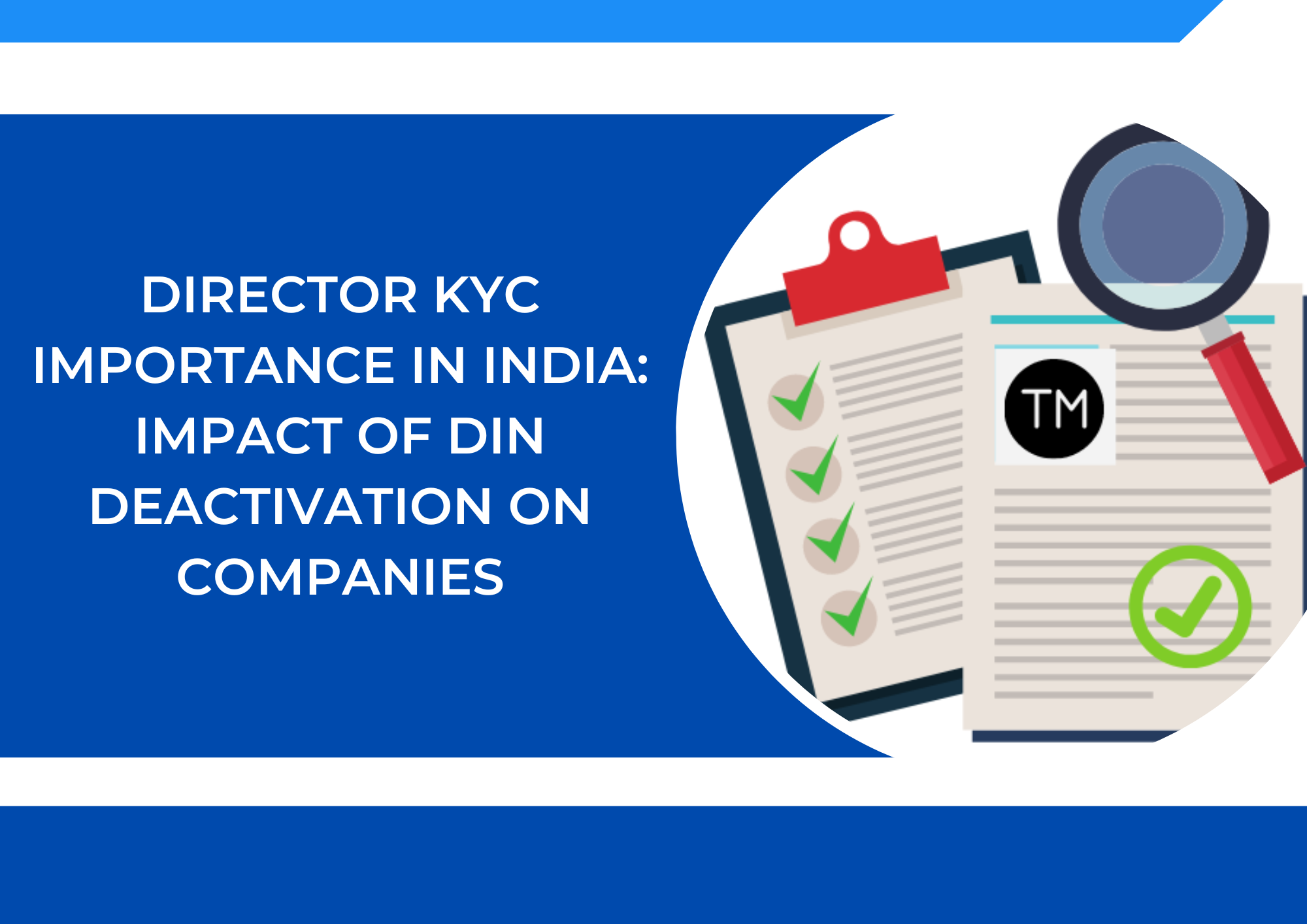
Director KYC is critical for every company in India. A deactivated DIN can block ROC filings, delay compliance, and impact funding. Learn the importance, rules, penalties, and how to stay compliant under the Companies Act, 2013.
- Director KYC: What Every Indian Company Must Know
- What Director KYC Actually Is
- The 2025 Amendment — What Changed and What Didn't
- What has not changed:
- Why Keeping Director KYC Updated Matters — For the Company, Not Just the Director
- What Updated Director KYC Protects
- The Practical Compliance Framework
- One Compliance Lapse. Multiple Business Consequences.
Director KYC: What Every Indian Company Must Know
There is a compliance obligation that most directors acknowledge but few treat with the urgency it deserves — Director KYC.
It looks simple on the surface. File a form. Verify your details. Done.
But when it lapses — and it lapses more often than founders realise — the consequences don’t stay with the director alone. They ripple outward, straight into the company’s ability to function, file, raise capital, and maintain credibility with regulators and investors alike.
Understanding why Director KYC matters, what it protects, and what a lapse actually costs — at the company level, not just the individual level — is essential reading for every founder, co-founder, and director of a Private Limited Company in India.
What Director KYC Actually Is
Director KYC is the process by which every individual holding a Director Identification Number (DIN) confirms and updates their personal details — name, address, contact information, PAN, and identification documents — with the Ministry of Corporate Affairs (MCA).
It is mandated under Rule 12A of the Companies (Appointment and Qualification of Directors) Rules, 2014, and was introduced in 2018 as part of the Government of India’s initiative to clean up the MCA’s director database, eliminate shell company misuse, and ensure that the regulatory system can make direct contact with every active DIN holder.
The logic is straightforward: a DIN is a legal identity. Just as citizens must maintain valid identity documents, directors must maintain verified, updated records with the authority that governs the corporate sector.
Who must file: Every individual whose DIN status is ‘Approved’ as on 31st March of a financial year — regardless of whether they are currently serving as a director on any company’s board. Resigned directors, inactive directors, and even disqualified directors with an active DIN are covered.
The 2025 Amendment — What Changed and What Didn’t
A significant update to Director KYC compliance was notified by the MCA on 31st December 2025 through the Companies (Appointment and Qualification of Directors) Amendment Rules, 2025, effective from 31st March 2026.
The key change: the annual filing requirement has been replaced with a triennial cycle — meaning directors now file KYC once every three consecutive financial years, with the deadline being 30th June of the year immediately following the third financial year. Directors who completed their KYC in FY 2025–26 will next be required to file by 30th June 2028.
What has not changed:
- The consequences of non-compliance remain identical — DIN deactivation and a ₹5,000 reactivation penalty
- Any change in mobile number, email address, or residential address must still be reported by filing DIR-3 KYC-Web within 30 days of such change — irrespective of where the director sits in their triennial cycle
- Form DIR-3 KYC-Web is now the sole prescribed form — the earlier dual system of e-Form and web form has been consolidated into a single web-based filing
The triennial system reduces procedural frequency. It does not reduce the stakes of a lapse.
Why Keeping Director KYC Updated Matters — For the Company, Not Just the Director
This is where most explanations fall short. They focus on what happens to the director. Here is what actually happens to the company when a director’s KYC lapses.
1. The Company Cannot File Critical ROC Forms
When a director’s DIN is deactivated due to non-filing of KYC, the company loses the ability to include that director’s DIN in any MCA form. This means:
- Form AOC-4 (financial statements) cannot be filed if it requires the signature of a director with a deactivated DIN
- Form MGT-7 (annual return) is similarly blocked
- Form DIR-12 (change in directorship), Form MGT-14 (resolutions), and other event-based filings are paralysed
For a two-director Private Limited Company — which describes the majority of startups and founder-owned businesses — one deactivated DIN can bring the entire compliance machinery to a halt.
2. No Documents Can Be Signed by That Director
A director with a deactivated DIN cannot sign statutory documents, board resolutions, or any form that requires their DIN number. In practical terms, they are legally frozen out of their directorial functions until the DIN is reactivated.
For companies where a founder-director is also a signatory on key operational agreements, this creates immediate operational risk beyond just compliance.
3. Fundraising and Due Diligence Take a Hit
Investor due diligence — at seed, Series A, or any subsequent round — involves a thorough review of MCA records. A deactivated DIN, missed KYC cycles, or compliance flags on the company’s filing history are red flags that sophisticated investors notice.
Similarly, if the company is pursuing a bank loan, a government tender, or a business acquisition, compliance gaps related to director identity records create doubt about governance quality. These are situations where the cost of a ₹5,000 penalty is irrelevant — the cost is in the opportunity lost.
4. Annual Compliance Deadlines Cascade
India’s corporate compliance calendar runs on a chain of dependencies. The AGM must happen by a certain date. AOC-4 and MGT-7 are due within defined windows after the AGM. TDS filings, advance tax payments, and GST reconciliations run on their own tracks.
When a director’s DIN is deactivated and the company cannot file its annual returns on time, late fees of ₹100 per day per form begin accumulating under the Companies Act, 2013 — entirely because of a KYC lapse that could have been avoided.
5. Reputational Signal to Regulators
The MCA’s compliance database is increasingly integrated with other regulatory systems. Companies that consistently miss Director KYC deadlines signal poor governance to the Registrar of Companies — creating a digital footprint that may attract scrutiny in other compliance contexts, including tax assessments, GST audits, and sector-specific licensing.
What Updated Director KYC Protects
Framing Director KYC only as a penalty-avoidance measure misses its broader value. Maintaining accurate, verified director records actively protects the company in several ways.
Fraud prevention: The original intent behind Director KYC was to identify and deactivate dormant or fraudulently held DINs being misused in shell company structures. A compliant company with verified director identities is insulated from regulatory scrutiny directed at such structures.
Communication integrity: The MCA uses registered mobile numbers and email addresses to communicate directly with directors about compliance notices, DIN status updates, and regulatory changes. Outdated contact details mean critical communications are missed — and ignorance of a regulatory notice is not a valid legal defence.
Corporate governance credibility: For companies that deal with institutional clients, large corporates, or government entities, clean MCA records are increasingly a prerequisite. The ability to demonstrate that all directors are KYC-compliant, DINs are active, and filing histories are clean is part of the governance narrative that serious businesses build.
The Practical Compliance Framework
Given that Director KYC under the revised rules is now a triennial obligation — with event-based updates required within 30 days of any change — here is what a sound compliance approach looks like:
Set a triennial compliance reminder: Map the next KYC due date to your company’s compliance calendar. For directors who filed in FY 2025–26, the next due date is 30th June 2028.
Monitor personal detail changes actively: The moment a director changes their mobile number, email address, or residential address, the 30-day update clock starts. This is now a rolling obligation, not a scheduled one.
Keep DSC current: For filings that require digital signature — including updates to contact details and DIN reactivation — a valid, registered Digital Signature Certificate is mandatory. DSC expiry at a critical moment is a common, avoidable compliance failure.
Engage a professional for reactivation cases: If a DIN has been deactivated, reactivation requires filing DIR-3 KYC-Web with the applicable fee. In some cases, a practising Chartered Accountant, Company Secretary, or Cost Accountant must certify the filing. Plan for this in advance rather than in crisis mode.
Verify DIN status periodically: The MCA portal allows directors to check DIN status at any time. A quarterly check takes minutes and confirms that the company’s directors are all in active, compliant standing.
One Compliance Lapse. Multiple Business Consequences.
Director KYC is not a form for its own sake. It is the foundation of the MCA’s trust in your company’s governance. When it is in order, everything flows — filings, appointments, fundraising, transactions. When it lapses, the company pays a price that goes well beyond a ₹5,000 penalty.
At Ofin Legal, we track Director KYC compliance for founders and directors across Private Limited Companies and LLPs in India. We ensure DINs remain active, deadlines are never missed, and your company’s MCA record stays clean — so you can focus on building, not untangling compliance knots.
Related Services :
Common Mistakes to Avoid While Filing DIR-3 KYC
Annual Compliance Checklist for Private Limited Companies
Ofin Legal Annual Compliance Services
Official Resources:
MCA Portal — DIN Services and DIR-3 KYC Filing — Ministry of Corporate Affairs
Press Information Bureau — MCA Triennial KYC Amendment Notification — Government of India official announcement
Companies Act, 2013 — Rule 12A — Ministry of Corporate Affairs
📞 Connect with Ofin Legal today — because one small lapse should not cost your company big.